
What It Costs You to Wait
A garage door that won't open rarely fixes itself, and waiting through another season of triple-digit heat usually turns a simple repair into a bigger one. A opener straining against a failing spring will burn out its gears faster. A door stuck half-open is an open invitation for dust, scorpions, and heat into the garage. And if the real problem is a broken spring, continuing to force the door with the opener can snap a cable, bend a track, or drop a heavy door section — turning a $150-$300 spring job into a repair that involves a new opener, track, or panel as well. If your door has been acting up for weeks and you've been meaning to "get to it," this is the season to actually get to it, before the desert heat finishes off whatever's already weak.
The Symptoms, Sorted
How the door fails tells a technician almost as much as what's broken. Before any tools come out, we're listening and watching for:
- Total silence — no motor hum, no lights, nothing happens when you press the button or remote.
- Motor hums but the door doesn't move — you hear effort, but no motion.
- Door starts to open, then reverses or stops partway.
- Remote doesn't work, but the wall button does (or vice versa).
- A loud bang was heard at some point, and the door hasn't worked right since.
- The door feels unusually heavy when lifted by hand.
The Order a Technician Actually Checks
1. Power to the Opener
First stop is always the simplest: is the opener actually getting power? Garage outlets are often on GFCI circuits, and dust intrusion or monsoon humidity can trip them more often than people expect. A tripped breaker, an unplugged cord (sometimes knocked loose during storage shuffling), or a dead outlet accounts for more "broken" openers than people assume. Fix: reset the GFCI, check the breaker panel, test the outlet.
2. Remote and Wall Control
If power is fine, next is the simplest of the electronics: battery life in the remote, loose wiring at the wall button, or signal interference. Intense heat can shorten battery life faster than in milder climates, so a remote that worked last month isn't a guarantee it works today. Fix: replace batteries, check wall button wiring, reprogram the remote if needed.
3. Safety Sensors (Photo Eyes)
These small sensors near the bottom of the tracks have to be aligned and unobstructed, or the opener won't run at all, sometimes without a clear error. Monsoon dust storms coat lenses quickly, and direct morning or evening sun can wash out the sensor's beam. Fix: wipe both sensor lenses, check that brackets haven't been bumped out of alignment, and re-test.
4. Manual Release / Disconnect Switch
If the emergency release cord was pulled — intentionally during a power outage, or accidentally by a stored item knocking into it — the door is mechanically disconnected from the opener even though everything else works fine. Fix: reconnect the trolley to the carriage and test the door manually before re-engaging the opener.
5. Springs
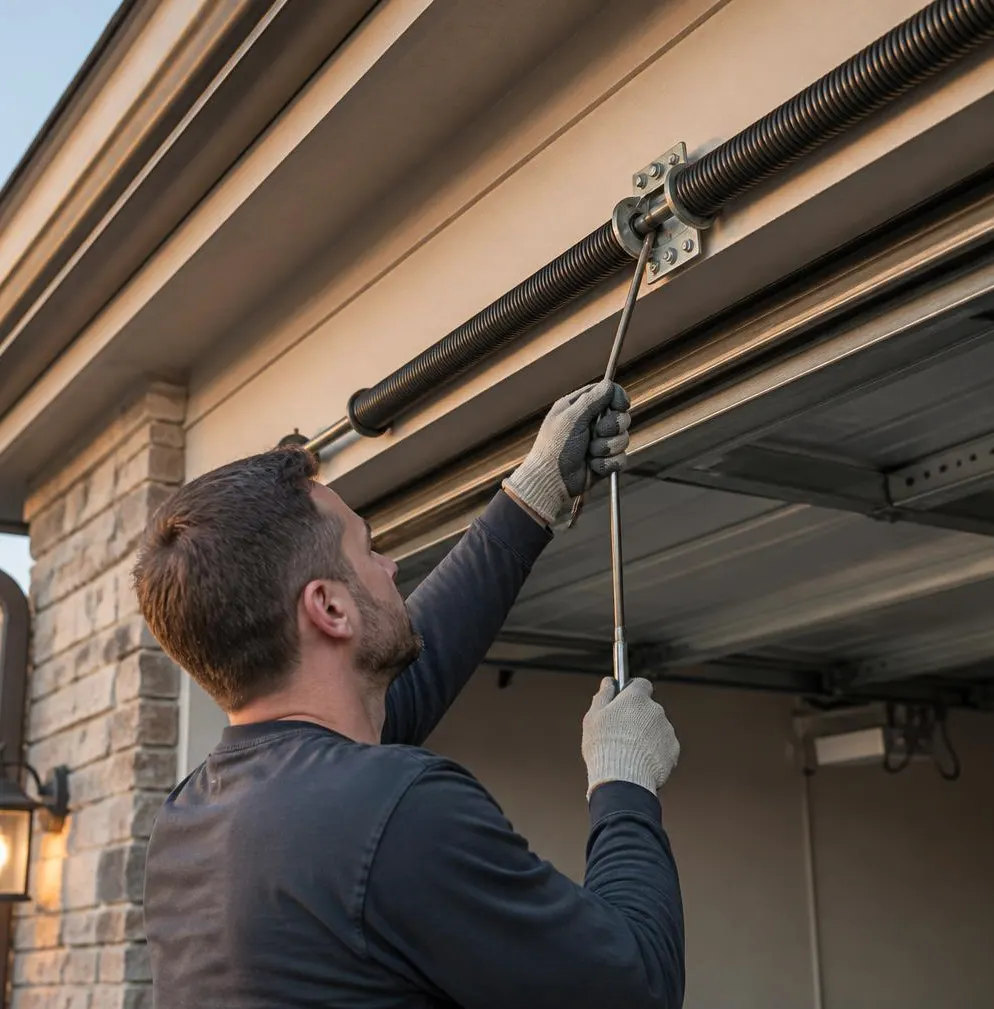
A loud bang, a door that suddenly feels much heavier, or an opener straining hard without moving the door are all signs of a broken torsion or extension spring. This is where DIY should stop — springs are under extreme tension and carry real injury risk. Fix: full spring replacement, matched to the door's weight and cycle count, done by a trained technician.
6. Cables and Pulleys
Frayed or off-track cables often show up alongside spring failure, since the two systems work together to balance the door. A cable that's slipped off its drum will cause the door to hang crooked or refuse to move evenly. Fix: cable re-seating or replacement, paired with a balance check.
7. Track Alignment and Rollers
Heat cycling causes metal tracks to expand and contract, and over years that can loosen mounting brackets or knock a track slightly out of alignment. Add in dust and dried-out roller lubricant — heat bakes grease out of rollers faster here than in milder climates — and you get binding, grinding, or a door that stops partway. Fix: realign tracks, replace worn rollers, re-lubricate with a heat-rated grease.
8. Opener Motor, Gears, and Logic Board
Last on the list because it's the most involved: stripped plastic drive gears, a burned-out motor, or a failed logic board. Chain and belt-drive openers both have internal gears that degrade faster under repeated heat exposure, especially in openers mounted against an uninsulated garage ceiling that bakes all summer. Fix: gear replacement if the rest of the unit is sound, or full opener replacement if the motor or board has failed.
When to Call Phoenix Overhead Door Co
If you've checked power, batteries, and sensors and the door still won't budge — or if you heard that bang and the door's gotten heavy — stop troubleshooting and call us. We handle Spring Replacement and Garage Door Opener Repair & Installation daily across the Phoenix metro, and we'll walk through this same checklist on-site, diagnose the actual point of failure, and quote the fix before any work starts. No guessing, no upsell on parts that aren't the problem.
If your garage door in Phoenix, Scottsdale, Tempe, or anywhere nearby has stopped opening, don't wait out another hot season on a bad spring or a dying opener. Call Phoenix Overhead Door Co today and we'll get your door moving again.